Holy Moly!!! Talk about Wind! Talk about Blowing Snow!
Wyoming is a whole 'nother kind of Winter. Its almost as flat as the Great Plains. The wind blows anything in its way. At 35 to 50 mph. Constantly. In Winter it blows the snow. You drive through it. Fortunately it is usually at ground level, but not always.
No pictures today; not much of what I would call scenic.
So I'm going to review the other thing I do on my road trips: read and listen to books.
Audiobooks:
Michael Punke, The Revenant. The movie is now out, but the book is still special enough to be read or listened to. Its a rough book. It is based on a mountain man who actually existed and relates events that either actually occurred or exist in legend. I liked it a lot.
Robert Littell, The Stalin Epigram. Another fictionalization of a real life. In this case, its the Russian poet Osip Mandelstam, who was arrested by the Soviet political police in 1934. At the time, the political police were still relying on extracting confessions that the accused recited in public show trials. Within a couple of years, Stalin and his henchmen had dispensed with confessions and merely held trials in which prosecutors recited accusations as statements of fact that were used to convict and condemn the accused. The novel's centerpiece is a poem that Mandelstam recited that was derogatory of Stalin. But the author indicates that what really infuriated Stalin was that even after torture and exile, he could not prevail on Mandelstam to recite a poem in which he sincerely complemented Stalin. It was a bit tedious.
James Carlos Blake, The House of Wolfe, A Border Noir. This is one of a serial on the Wolfe family, a criminal enterprise in Texas and Mexico that had its fictional start with a sea captain turned pirate who was supposedly hanged in Vera Cruz in the 1840s. This episode involves the kidnapping of a female member of the Texas Wolfe clan in Mexico and her recovery due to the combined efforts of the Texas and Mexico branches of the family. Smuggling and violence are the hallmarks of the Wolfes, and Blake's books are a fast read (or listen) and a lot of fun.
Viet Thanh Nguyen, The Sympathizer. I am currently listening to this audiobook. The narrator is a South Vietnamese army officer who served as chief of staff to a general who was head of the secret police. Both are flown out of Saigon in 1975 just before the North's takeover of the city. The narrator has been a VC plant within the South's secret police and he is ordered to continue his surveillance and reports on the general's machinations in the USA. That's it so far.
Books on Kindle:
Martin Lynch, Mining in World History. I read this as a followup of my trip with Jeff last November to Southeast Arizona and Southwest New Mexico. We visited-observed-toured four open-pit copper mines. The book was every bit as interesting as the title makes it sound, but I feel I learned a lot.
State of Terror: The War Against ISIS. A compilation of Washington Post articles on ISIS over the past year.
Currently reading:
Michael McCarthy, Ashes Under Water: The SS Eastland and the Shipwreck That Shook America.
John Grisham, Gray Mountain.
Aleksandr Solzhenitsyn, The First Circle.
Peter Annin, The Great Lakes Water Wars.
Marlon James, A Brief History of Seven Killings: A Novel. the 2015 Man Booker Prize winner
Day 10 mileage: 395
Cumulative mileage: 3,165
Tuesday, January 12, 2016
Monday, January 11, 2016
Kanab, Utah to Grand Junction, Colorado
Southeastern Utah has some of the most incredible scenery in the world. Buttes, ridges, reefs, shelves, plateaus, on and on. The lineup of national parks alone is exceptional: Arches, Bryce Canyon, Canyonlands, Capital Reef, and Zion. Plus the national monuments: Cedar Breaks, Grand Staircase-Escalante, Hovenweep, Natural Bridges, and Rainbow Bridge. Plus 12 Utah state parks. I have traveled through the area five times, and I am always amazed.
This was my first time driving the length of Utah Highway 12. It is definitely one of the most amazing scenic highways in the country. And if you drive it in winter, like I did, you almost have it to yourself. I like the geology. I like the elevation, from 5000 feet to 9600 feet. I like the curves and the hills, both up and down. I like the numerous turnouts and scenic viewpoints--all of which had been plowed of snow.
That's enough superlatives. Here are the pictures. I think the snow adds an interesting element to the landscapes.
While Colorado has Chimney Rock National Monument, Utah has its own Chimney Rock in Capital Reef National Park.
Day 9 mileage: 400
Cumulative mileage: 2,770
This was my first time driving the length of Utah Highway 12. It is definitely one of the most amazing scenic highways in the country. And if you drive it in winter, like I did, you almost have it to yourself. I like the geology. I like the elevation, from 5000 feet to 9600 feet. I like the curves and the hills, both up and down. I like the numerous turnouts and scenic viewpoints--all of which had been plowed of snow.
That's enough superlatives. Here are the pictures. I think the snow adds an interesting element to the landscapes.
 |
| Bryce Canyon |
 |
| Bryce Point, Bryce Canyon |
 |
| Grottos from Bryce Point, Bryce Canyon |
 |
| Bryce Canyon |
 | |
| Scene from Utah Highway 12 |
 |
| Snow, Utah Style |
While Colorado has Chimney Rock National Monument, Utah has its own Chimney Rock in Capital Reef National Park.
 |
| Chimney Rock, Capital Reef National Park |
Cumulative mileage: 2,770


Sunday, January 10, 2016
Cortez, Colorado to Kanab, Utah
When I left Cortez, the temperature was two degrees Fahrenheit. It was dry and the sky was clear, so my major concern was ice on the roadway. Fortunately, the road was dry and ice-free all morning.
My key objective was to take winter pictures of Monument Valley. The area, well known from many Western movies, is on the Navajo Tribe Reservation in Arizona. The tribe has incorporated it into a Tribal Park and charges a $20 per car fee for entry. Things looked good until I was very near the park, but then the cloud cover decreased to zero. In addition, the park attendant advised that the park road, which is not paved, was closed due to the recent rain and snow. At least they we're charging the entry fee and I went to the visitors center. The the best views are within the park, but I was able to take some pictures of mesas and buttes in the surrounding territory.


Day 8 mileage: 365
Cumulative mileage: 2,370
My key objective was to take winter pictures of Monument Valley. The area, well known from many Western movies, is on the Navajo Tribe Reservation in Arizona. The tribe has incorporated it into a Tribal Park and charges a $20 per car fee for entry. Things looked good until I was very near the park, but then the cloud cover decreased to zero. In addition, the park attendant advised that the park road, which is not paved, was closed due to the recent rain and snow. At least they we're charging the entry fee and I went to the visitors center. The the best views are within the park, but I was able to take some pictures of mesas and buttes in the surrounding territory.
 |
| Mexican Hat |


Day 8 mileage: 365
Cumulative mileage: 2,370
Saturday, January 9, 2016
Durango, Colorado to Cortez, Colorado via Telluride
I stayed an extra day in Durango to allow the final stage of the storm to pass through southwest Colorado.
Durango is a small western- and outdoors-oriented city that is most active during the summer months. It reminded me of Jackson Hole, Wyoming. A major attraction is the Durango-Silverton Narrow Gauge Railroad, which is probably the best scenic railway in the country. It runs year round. If I had a bucket list, riding it would be on it, though I would prefer to ride it during the Summer. I had an excellent prime rib dinner at Ken and Sue's in downtown Durango. There appear to be several fine restaurants in town.
Today I traveled North from Durango up the San Juan Skyway to Ouray, Colorado. I crossed three passes on the 50-mile drive, with the Red Mountain Summit Pass being the highest at 11,100 feet above sea level. Mandatory traction control was required of all vehicles, including passenger cars. Because I did not have either all wheel drive or snow tires, in dutifully put on my chains. It took me about 10 minutes to install them. All the way over the three passes, I did not see chains on any other passenger vehicle. Ho Hum. I will say that I felt much safer with the chains installed, and since they kept me from driving faster than 25 mph, I had a very pleasant drive in the beautiful scenery.
Day 7 mileage: 245
Cumulative mileage: 2,005
Here are some pictures:
Durango is a small western- and outdoors-oriented city that is most active during the summer months. It reminded me of Jackson Hole, Wyoming. A major attraction is the Durango-Silverton Narrow Gauge Railroad, which is probably the best scenic railway in the country. It runs year round. If I had a bucket list, riding it would be on it, though I would prefer to ride it during the Summer. I had an excellent prime rib dinner at Ken and Sue's in downtown Durango. There appear to be several fine restaurants in town.
Today I traveled North from Durango up the San Juan Skyway to Ouray, Colorado. I crossed three passes on the 50-mile drive, with the Red Mountain Summit Pass being the highest at 11,100 feet above sea level. Mandatory traction control was required of all vehicles, including passenger cars. Because I did not have either all wheel drive or snow tires, in dutifully put on my chains. It took me about 10 minutes to install them. All the way over the three passes, I did not see chains on any other passenger vehicle. Ho Hum. I will say that I felt much safer with the chains installed, and since they kept me from driving faster than 25 mph, I had a very pleasant drive in the beautiful scenery.
Day 7 mileage: 245
Cumulative mileage: 2,005
Here are some pictures:
 |
| Peak on San Juan Skyway |
 |
| Mustang with Chains in Silverton, Colorado |
 | |||||||
| San Juan County Courthouse in Silverton, Colorado |
 |
| Main Street in Ouray, Colorado |
 | ||
| San Juan Mountains from San Juan Skyway |
Thursday, January 7, 2016
Raton, New Mexico to Durango, Colorado
I'm now in a lot of snow. I'm now in Colorado. But I repeat myself.
I traveled over three mountain passes today, at successively greater heights and more hazardous road conditions. First was Raton Pass at 7835 feet above sea level, then North La Veta Pass in the Sangre de Cristo Mountains at 9413 feet, and finally Wolf Creek Pass in the San Juan Mountains at 10,856 feet. Snow covered the area like a blanket, all fresh and white. It goes on and on for hour after hour of driving. I didn't have to put on chains at any point, and I did no sliding as I mostly drove at 30 to 35 MPH. It was an amazing seven hours of driving.
There was a national monument on the way and I wanted to check it out, but it was closed for the season. The monument was created by President Barack Obama on September 21, 2012. (Fox News claimed it was a blatant political ploy to secure the vote of the Southern Ute Tribe). The pinnacle is on land that was already in the San Juan National Forest, and is adjacent to the Southern Ute Tribe Reservation. Its significance is as an archaeological feature as site of ancestral Puebloan ceremonial activity. From Wikipedia:
"The construction of the Great House Pueblo at the top of the ridge, close to Chimney Rock and its neighbor Companion Rock, had a large ceremonial role in the later years of Chaco presence. As the moon makes its lunar cycle across the sky over a period of 18.6 years, it appears in a "lunar standstill" between the two rocks every 9.3 [years] for a period of approximately 2 years. Evidence suggests that Great House Pueblo was first built in 1076 during a lunar standstill and expanded and finished in 1093 during another."
The peaks (or rocks) caught my eye as I was driving by outside of Durango, and I snapped this picture:
I made that up about Fox News.
Day 5 mileage: 300
Cumulative mileage: 1,760
I traveled over three mountain passes today, at successively greater heights and more hazardous road conditions. First was Raton Pass at 7835 feet above sea level, then North La Veta Pass in the Sangre de Cristo Mountains at 9413 feet, and finally Wolf Creek Pass in the San Juan Mountains at 10,856 feet. Snow covered the area like a blanket, all fresh and white. It goes on and on for hour after hour of driving. I didn't have to put on chains at any point, and I did no sliding as I mostly drove at 30 to 35 MPH. It was an amazing seven hours of driving.
 |
| Approaching Wolf Creek Pass |
There was a national monument on the way and I wanted to check it out, but it was closed for the season. The monument was created by President Barack Obama on September 21, 2012. (Fox News claimed it was a blatant political ploy to secure the vote of the Southern Ute Tribe). The pinnacle is on land that was already in the San Juan National Forest, and is adjacent to the Southern Ute Tribe Reservation. Its significance is as an archaeological feature as site of ancestral Puebloan ceremonial activity. From Wikipedia:
"The construction of the Great House Pueblo at the top of the ridge, close to Chimney Rock and its neighbor Companion Rock, had a large ceremonial role in the later years of Chaco presence. As the moon makes its lunar cycle across the sky over a period of 18.6 years, it appears in a "lunar standstill" between the two rocks every 9.3 [years] for a period of approximately 2 years. Evidence suggests that Great House Pueblo was first built in 1076 during a lunar standstill and expanded and finished in 1093 during another."
The peaks (or rocks) caught my eye as I was driving by outside of Durango, and I snapped this picture:
 |
| Chimney Rock, right, and Companion Rock, left |
I made that up about Fox News.
Day 5 mileage: 300
Cumulative mileage: 1,760
Wednesday, January 6, 2016
Woodward, Oklahoma to Raton, New Mexico
Today I finished crossing the Great Plains. The drive seems flat, but over a distance of 250 miles the elevation increased from 2000 feet to 5000 feet.
On the last third of the drive, a series of scattered "hills" appeared. They are actually mountains because their elevations are 6000 to 8000 feet above sea level. They are part of over 100 ancient volcanic vents located in the northeast corner of New Mexico between Clayton and Raton. Volcanoes in the middle of a tectonic plate are very unusual. Apparently, in this area the earth's crust spread and thinned, and a magma hot spot was periodically able to push to the surface. This process began about six million years ago. Three series of volcanoes formed in this area. Erosion has cased most of the older two series to be reduced to ridges and hillocks. The last series started two million years ago and only ended 40,000 years ago.
One of these newer volcanoes, Capulin, was designated a national monument by President Woodrow Wilson in 1916. Its age is believed to be 60,000 years. The volcano consists of a cinder cone and about 25 square miles of lava beds. As a national monument, the volcano is protected and maintained by rangers of the National Park Service. In 1925, a road was carved in the cinders along the side of cone, so I was able to drive to the edge of the cone. The inside of the cone is not much to look at, other than to evaluate the forces that created the volcano. Here are some pictures:
The National Park System was established by Congress during the presidency of Theodore Roosevelt. The legislation provided for the establishment of national parks and national monuments. A new national park required specific Congressional action. A new national monument could be established by presidential order and did not require Congressional approval (though, of course, annual appropriations require Congressional approval). This distinction has been of major importance because there are many more national monuments than national parks, and generally the protection afforded can be more quickly obtained. For example, The Grand Canyon was declared a national monument by President Theodore Roosevelt in 1908, and didn't become a national park until 1919. The Wikipedia entry says this:
"U.S President Theordore Roosevelt visited the Grand Canyon in 1903. An avid outdoorsman and staunch conservationist, he established the Grand Canyon Game Preserve on November 28, 1906. Livestock grazing was reduced, but predators such as mountain lions, eagles, and wolves were eradicated. Roosevelt added adjacent national forest lands and redesignated the preserve a U.S. National Monument on January 11, 1908. Opponents such as land and mining claim holders blocked efforts to reclassify the monument as a U.S. National Park for 11 years. Grand Canyon National Park was finally established as the 17th U.S. National Park by an Act of Congress signed into law by President Woodrow Wilson on February 26, 1919.[17]
Tomorrow, January 7th, should be an interesting drive. Snow will be falling, though most of the way it will be light, at one to three inches. However, I have to cross the Sangre de Cristo Mountains, with North La Veta Pass at 9413 feet above sea level. I have to cross it to get to Durango, Colorado by tomorrow night. I won't know if I can get across the pass until I get in the area. If I can't I'll retreat and stay in Walsenburg or Pueblo.
Day 4 mileage: 330
Cumulative mileage: 1,460
On the last third of the drive, a series of scattered "hills" appeared. They are actually mountains because their elevations are 6000 to 8000 feet above sea level. They are part of over 100 ancient volcanic vents located in the northeast corner of New Mexico between Clayton and Raton. Volcanoes in the middle of a tectonic plate are very unusual. Apparently, in this area the earth's crust spread and thinned, and a magma hot spot was periodically able to push to the surface. This process began about six million years ago. Three series of volcanoes formed in this area. Erosion has cased most of the older two series to be reduced to ridges and hillocks. The last series started two million years ago and only ended 40,000 years ago.
One of these newer volcanoes, Capulin, was designated a national monument by President Woodrow Wilson in 1916. Its age is believed to be 60,000 years. The volcano consists of a cinder cone and about 25 square miles of lava beds. As a national monument, the volcano is protected and maintained by rangers of the National Park Service. In 1925, a road was carved in the cinders along the side of cone, so I was able to drive to the edge of the cone. The inside of the cone is not much to look at, other than to evaluate the forces that created the volcano. Here are some pictures:
 | |||
| Capulin Mountain at Capulin Volcano National Monument, New Mexico |
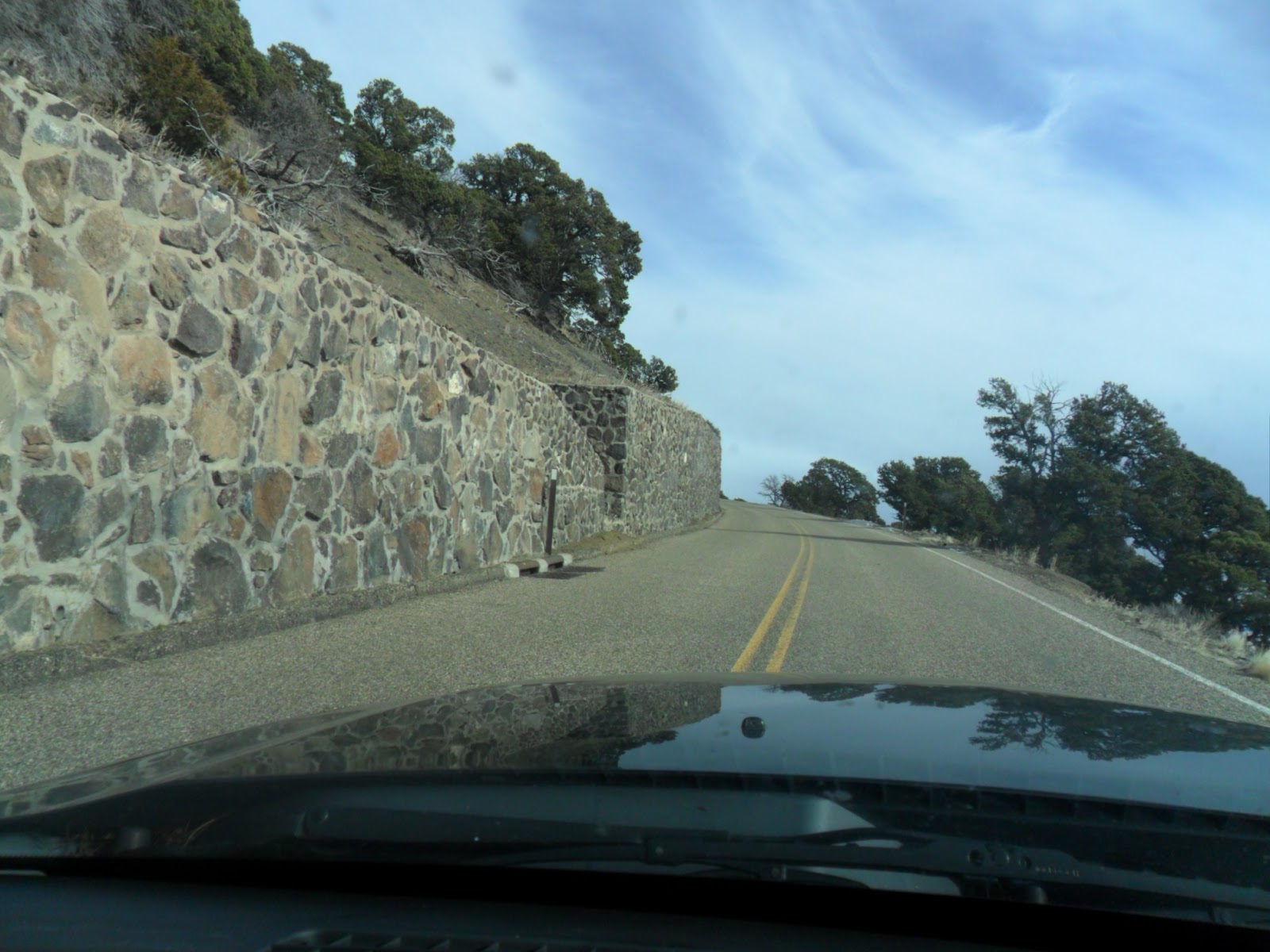 |
| Road to Cone Top, Capulin Volcano |
 |
| Capulin Volcano Inner Cone |
The National Park System was established by Congress during the presidency of Theodore Roosevelt. The legislation provided for the establishment of national parks and national monuments. A new national park required specific Congressional action. A new national monument could be established by presidential order and did not require Congressional approval (though, of course, annual appropriations require Congressional approval). This distinction has been of major importance because there are many more national monuments than national parks, and generally the protection afforded can be more quickly obtained. For example, The Grand Canyon was declared a national monument by President Theodore Roosevelt in 1908, and didn't become a national park until 1919. The Wikipedia entry says this:
"U.S President Theordore Roosevelt visited the Grand Canyon in 1903. An avid outdoorsman and staunch conservationist, he established the Grand Canyon Game Preserve on November 28, 1906. Livestock grazing was reduced, but predators such as mountain lions, eagles, and wolves were eradicated. Roosevelt added adjacent national forest lands and redesignated the preserve a U.S. National Monument on January 11, 1908. Opponents such as land and mining claim holders blocked efforts to reclassify the monument as a U.S. National Park for 11 years. Grand Canyon National Park was finally established as the 17th U.S. National Park by an Act of Congress signed into law by President Woodrow Wilson on February 26, 1919.[17]
Tomorrow, January 7th, should be an interesting drive. Snow will be falling, though most of the way it will be light, at one to three inches. However, I have to cross the Sangre de Cristo Mountains, with North La Veta Pass at 9413 feet above sea level. I have to cross it to get to Durango, Colorado by tomorrow night. I won't know if I can get across the pass until I get in the area. If I can't I'll retreat and stay in Walsenburg or Pueblo.
Day 4 mileage: 330
Cumulative mileage: 1,460
Tuesday, January 5, 2016
Springdale, Arkansas to Woodward, Oklahoma
This is the day I crossed most of Oklahoma, from East to West, including the panhandle. I was pretty good. Cold, but good. On the easterrn side of the state, there was a hilly scenic drive on US Highway 62. The middle of the state was fairly flat. And a little northwest of Oklahoma City, snow started to appear on the ground. In the western part of the state, there was slight blanket of snow everywhere. I have traveled cross country several times, and I think Oklahoma is about the most scenic way to cross the Great Plains.
One of the things I like most about my road trips is listening to audiobooks along the way. Over the past two days I have listened to The Revenant by Michael Punke. It is the basis of a movie of the same name starring Leonardo DiCaprio coming out this month. Its rated as a historical fiction, but I classify it as a survival fiction. I consider Hemingway's The Old Man and the Sea as the first survival fiction I read. The similarity is the overcoming a series of extreme adverse situations in a hostile environment with an ambiguous outcome. I have heard that DiCaprio has done an outstanding job as the lead character, Hugh Glass, who was an actual mountain man who was terribly mauled by a grizzley bear, and then was left to die by two men who had agreed to stay with him. All I can say is that this is certainly a different role from anything I had seen DiCaprio do before. The book is great, and is certainly worth reading or listening to even if you see the movie.
Day 3 mileage: 345
Cumulative mileage: 1,130
One of the things I like most about my road trips is listening to audiobooks along the way. Over the past two days I have listened to The Revenant by Michael Punke. It is the basis of a movie of the same name starring Leonardo DiCaprio coming out this month. Its rated as a historical fiction, but I classify it as a survival fiction. I consider Hemingway's The Old Man and the Sea as the first survival fiction I read. The similarity is the overcoming a series of extreme adverse situations in a hostile environment with an ambiguous outcome. I have heard that DiCaprio has done an outstanding job as the lead character, Hugh Glass, who was an actual mountain man who was terribly mauled by a grizzley bear, and then was left to die by two men who had agreed to stay with him. All I can say is that this is certainly a different role from anything I had seen DiCaprio do before. The book is great, and is certainly worth reading or listening to even if you see the movie.
Day 3 mileage: 345
Cumulative mileage: 1,130
Monday, January 4, 2016
Memphis, Tennessee to Springdale, Arkansas
Very smooth driving today in 33 degree weather. Northeastern Arkansas was very flat, with evidence of flooding in the vicinity of the rivers. The White River has a very large relief basin and it was full of water. I spent the afternoon traveling through the Arkansas Ozarks, which is always a pleasant drive. This is the fourth time I have traveled in the Ozarks. While they are old mountains like the Appalachians, they are very different. The Appalachians are granite and metamorphic schist, while the Ozarks are limestone and sandstone. That's all the geology for today.
I checked out the Mississippi in Memphis. Like much of the Mississippi, the river at Memphis is at flood stage. The flood crest is not due to reach Memphis until the end of the week. The city has a nice riverview park outside of the levee, just south of downtown. Below is a picture showing the river up to the park. It also shows the levee that protects the downtown area of the city. It appears to be 30 ro 40 feet above the riverview park. I suspect the flood at its crest stage may inundate the park, but there is no possibility of the river exceeding the height of the levee. However, like a chain, a levee is only as strong as its weakest part, so there is always room for worry. This reminds me of the book I read about the flood of the Mississippi Delta (which is located in the State of Mississippi, and is not in fact the delta of the Mississippi River). The book, by John Barry, is Rising Tide: The Great Mississippi Flood of 1927 and How It Changed America. It is a great popular history read. The levees broke that time and over ten feet of water inundated hundreds of square miles for several months.
Day 2 Mileage: 355
Cumulative Mileage: 785
I checked out the Mississippi in Memphis. Like much of the Mississippi, the river at Memphis is at flood stage. The flood crest is not due to reach Memphis until the end of the week. The city has a nice riverview park outside of the levee, just south of downtown. Below is a picture showing the river up to the park. It also shows the levee that protects the downtown area of the city. It appears to be 30 ro 40 feet above the riverview park. I suspect the flood at its crest stage may inundate the park, but there is no possibility of the river exceeding the height of the levee. However, like a chain, a levee is only as strong as its weakest part, so there is always room for worry. This reminds me of the book I read about the flood of the Mississippi Delta (which is located in the State of Mississippi, and is not in fact the delta of the Mississippi River). The book, by John Barry, is Rising Tide: The Great Mississippi Flood of 1927 and How It Changed America. It is a great popular history read. The levees broke that time and over ten feet of water inundated hundreds of square miles for several months.
 | ||
| Mississippi River at Memphis Riverview Park with Levee in Background |
Cumulative Mileage: 785
Sunday, January 3, 2016
Hiawassee, Georgia to Memphis, Tennessee
I started out at 9 AM from home near Hiawassee, Georgia, looking at a leisurely 400-mile drive to Memphis, Tennessee. The drive took about eight hours and the weather was fine all the way.
The so-called Winter Storm Goliath occurred between Christmas and New Years and caused (and is causing) considerable flooding in the Mississippi-Missouri-Ohio river system. The Hiawassee River and TVA Lake Chatuge are part of this system. Lake Chatuge is half in Hiawassee/Towns County, Georgia and half in North Carolina. It was formed by the TVA construction of a dam in North Carolina in 1940. Chatuge Dam is operated by the TVA to generate electricity, to provide recreational opportunities, and for flood control. During Winter the lake is usually maintained about 10 feet below its "full" level, and then gradually raised in Spring to "full" by June 1 for recreational use of the lake. Then in September and October it is dropped back to its Winter level. I assume TVA manipulates the opening and closing of the discharge pipes to the dam's turbines to manipulate the water level. Significant rain during WS Goliath brought a lot of rain to the area and filled up Lake Chatuge above is "full" level, and feeder creeks flooded and caused road damage.
On my way out of town, I decided to check on the status of Chatuge Dam, as I had never seen the lake this high. Chatuge Dam is an earth-and-rock-filled dam with a concrete spillway that discharges at about eight to ten feet below the top of the dam. I had never seen any water in the spillway. As these pictures show, the lake is flood-full and a few inches of water are being discharged over the spillway.
Hiawassee River discharges into the Tennessee River, which combines with the Cumberland River and pours into the Ohio River, which then merges with the Mississippi River. I had assumed that TVA was actively engaged in flood control on its upriver dams to reduce downriver flooding. Active flood control, to me, would mean closing the discharge pipes on the upriver dams. As I indicated, Lake Chatuge is flood-full and water is passing over the spillway. But when I crossed the Hiawassee River about a quarter-mile below the dam, it was full, meaning the discharge pipes were fully open. I conclude that the rainfall and river flow has been so great that all TVA can do in the way of flood control is to passively allow the lake to hold as much water as it can, and discharge the remainder downstream. If this is the case throughout the river system, then WS Goliath taxed the flood control aspect of the system to its capacity, and any more rain in the near future is likely to cause more downstream flooding.
Tomorrow I will be crossing the Mississippi River and traveling in Arkansas. The river at Memphis is above flood stage and has not yet crested. The worst of the flooding has occurred in Missouri, and will be to the North of me.
The other thing I noticed on my drive was the substantial amount of ground-level green across North Alabama and North Mississippi. I think this is a reflection of the mild winter so far, plus the recent rain followed by relatively warm temperatures.
Day 1 mileage: 430
The so-called Winter Storm Goliath occurred between Christmas and New Years and caused (and is causing) considerable flooding in the Mississippi-Missouri-Ohio river system. The Hiawassee River and TVA Lake Chatuge are part of this system. Lake Chatuge is half in Hiawassee/Towns County, Georgia and half in North Carolina. It was formed by the TVA construction of a dam in North Carolina in 1940. Chatuge Dam is operated by the TVA to generate electricity, to provide recreational opportunities, and for flood control. During Winter the lake is usually maintained about 10 feet below its "full" level, and then gradually raised in Spring to "full" by June 1 for recreational use of the lake. Then in September and October it is dropped back to its Winter level. I assume TVA manipulates the opening and closing of the discharge pipes to the dam's turbines to manipulate the water level. Significant rain during WS Goliath brought a lot of rain to the area and filled up Lake Chatuge above is "full" level, and feeder creeks flooded and caused road damage.
On my way out of town, I decided to check on the status of Chatuge Dam, as I had never seen the lake this high. Chatuge Dam is an earth-and-rock-filled dam with a concrete spillway that discharges at about eight to ten feet below the top of the dam. I had never seen any water in the spillway. As these pictures show, the lake is flood-full and a few inches of water are being discharged over the spillway.
 |
| Chatuge Dam Spillway, near Hiawassee, GA |
 |
| Chatuge Dam at Flood-Full, Adjacent to Spillway |
Hiawassee River discharges into the Tennessee River, which combines with the Cumberland River and pours into the Ohio River, which then merges with the Mississippi River. I had assumed that TVA was actively engaged in flood control on its upriver dams to reduce downriver flooding. Active flood control, to me, would mean closing the discharge pipes on the upriver dams. As I indicated, Lake Chatuge is flood-full and water is passing over the spillway. But when I crossed the Hiawassee River about a quarter-mile below the dam, it was full, meaning the discharge pipes were fully open. I conclude that the rainfall and river flow has been so great that all TVA can do in the way of flood control is to passively allow the lake to hold as much water as it can, and discharge the remainder downstream. If this is the case throughout the river system, then WS Goliath taxed the flood control aspect of the system to its capacity, and any more rain in the near future is likely to cause more downstream flooding.
Tomorrow I will be crossing the Mississippi River and traveling in Arkansas. The river at Memphis is above flood stage and has not yet crested. The worst of the flooding has occurred in Missouri, and will be to the North of me.
The other thing I noticed on my drive was the substantial amount of ground-level green across North Alabama and North Mississippi. I think this is a reflection of the mild winter so far, plus the recent rain followed by relatively warm temperatures.
Day 1 mileage: 430
Saturday, December 19, 2015
WINTER TREK - JANUARY 2016
I am planning to spend about 2 to 3 weeks in January 2016 driving through the central and west United States in my 2007 Mustang GT. The idea is to experience driving in winter weather conditions, including winding roads and elevation. A lot of the trip will be in Colorado. Its sort of like making a winter trip to Colorado to ski, but without the skiing. I have new all-weather performance tires and cable-type chains for the rear wheels, which are the drive wheels. As usual on my road trips, I will be traveling on my own. Because of the weather, I will be staying in motels. I will be adjusting my route and distance daily to accommodate weather and driving conditions and my own fitness. This is my proposed route and schedule:Day One - Hiawassee, GA to Memphis, TN. 430 miles,
minimum driving time 7 hours.
Day Two - Memphis, TN to Springdale, AR. 320 miles, 6 hours.
Travel through the Ozarks.
Day Three - Springdale, AR to Woodward, OK. 360 miles, 6 hours 30 minutes.
Day Four - Woodward, OK to Raton, NM. 320 miles, 5 hours.
Day Five - Raton, NM to Durango, CO. 280 miles, 4 hours 30 minutes
Day Six - Durango, CO to Cortez, CO via Telluride, CO. 200 miles, 6 hours.
San Juan Skyway
Million Dollar Highway
Ouray Hot Springs Pool and Fitness Center
Telluride/Mountain View Gondola
Day Seven - Cortez, CO to Page, AZ. 290 miles, 5 hours 30 minutes.
Hovenweep National Monument
Monument Valley
Day Eight - Page, AZ to Green River, UT. 360 miles, 6 hours.
Utah Highway 12
Day Nine - Green River, UT to Gunnison, CO. 370 miles, 7 hours 30 minutes
Alternate intermediate stop: Glenwood Springs, CO
Green River UT to Glenwood Springs, CO. 210 miles, 4 hours.
Glenwood Springs, CO to Gunnison, CO. 160 miles, 3 hours
30 minutes.
Day Ten - Gunnison, CO to Golden, CO. 270 miles, 7 hours.
Day Eleven - Golden, CO to Gillette, WY. 360 miles, 7 hours
Powder River Basin Coal Area
Day Twelve - Gillette, WY to Hot Springs, SD. 230 miles, 5 hours.
Devil's Tower
Black Hills
Day Thirteen - Hot Springs, SD to Norfolk, NE. 380 miles, 6 hours.
Day Thirteen (alternate) - Hot Springs, SD to Sioux City, IA. 430 miles. 7 hours.
Day Fourteen - Norfolk, NE to Naperville, IL. 530 miles, 8 hours.
Midwest Regional Hosta Society Winter Meeting
Day Fourteen (alternate) - Sioux City, IA to Madison, WI. 400 miles. 6 hours.
Visit with Michael Eggen's family
Day Fifteen - Naperville, IL to Canton, MI. 280 miles, 4 hours 30 minutes.
Visit with Jeff Eggen's family
North American International Auto Show
Day Fifteen (alternate) - Madison, WI to Canton, MI. 410 miles. 6 hours.
Visit with Jeff Eggen's family
North American International Auto Show
Day Sixteen - Canton, MI to Lexington, KY. 340 miles, 5 hours 30 minutes
Day Seventeen - Lexington, KY to Hiawassee, GA. 340 miles, 5 hours 30 minutes
Subscribe to:
Comments (Atom)