We left Mom and Dad, carrying seven bottles of wine furnished by Dad, and headed back up through the Coast Range to San Francisco. I decided on a detour onto California Highway 25, the "Airline Highway." No explanation found for the nickname. It travels northwest from a point east of San Lucas to Hollister and on to Gilroy. The attraction is that it follows the San Andreas Fault. That was a bit of a disappointment. We were hoping for a deep crevasse where we could dare each other to jump in, as in "if you really love me you'll . . . ." No crevasse. In this area the fault is a creeping fault, which means it moves continuously at a rate of about three-tenths of an inch per year. The sides of the fault don't come into complete contact and don't build up stress, and thus there are no earthquakes in this area. So there are just gently rolling hills with a small valley in between. The only traffic was ranchers checking their cattle and motorcyclists out for a ride.
The other attraction of Highway 25 is Pinnacles National Monument. It was one of three national monuments designated by President Theodore Roosevelt in January 1908, along with Grand Canyon and Muir Woods. If you look at a map it looks like you can drive east on state road 146 from US highway 101 through the monument to highway 25. No go. The road stops about two miles from the entrance on the west side and about four miles from the entrance on the east side. The other problem is you can't see the rhyolite pinnacles from the road or parking lots. You have to hike at least a couple of miles, which wasn't on our itinerary. Pinnacles consist of a volcanic field that erupted about 23 million years ago. It is located west of the San Andreas Fault, so it has been moving northwest on the Pacific Plate. The fault itself passed through the volcanic field, and the other part of it is about 200 miles southwest near Lancaster, California, on the western end of the Mojave Desert. That little factoid was used as part of the evidence to establish the theory of plate tectonics.
We also had dinner with Hub and Jacob at the Chenery Park Restaurant in the San Francisco neighborhood of Glen Park, near Daly City. Good food and delightful conversation. Julie flies home on Monday and I continue on to Northern California and Oregon for a couple of weeks of trekking.
Mileage: 285. Cumulative mileage: 695.
Monday, October 17, 2011
Saturday, October 15, 2011
Pensacola, FL to San Luis Obispo, CA
Julie and I are on a trip to California, primarily to see Mom and Dad. We are staying at Shell Beach, which is South of San Luis Obispo and is part of Pismo Beach. We are staying in a motel on the bluffs overlooking the Pacific Ocean. The scenery is exquisite and is similar to the fabled Big Sur area to the North.
The cliffs are part of the Franciscan formation, which is a jumble of rocks resulting from the Pacific tectonic plate sliding under the North American plate. Because most of the rock is sedimentary, you can tell its horizontal position when it was laid down. The process of subduction has resulted it this sedimentary rock being scraped off and left, helter-skelter, in and above the trench and forming the mountains of the Coastal Range in California. As I said, you can tell what was the horizontal position of the sediment when it was laid down. Now the sedimentary rocks go at all different angles, with some slabs very close together but at 90 degrees to 120 degrees different in angle. It makes for a very confusing sight.
The onslaught of the Pacific's pounding surf is eroding the cliffs in dramatic and scenic fashion. The sedimentary rock is rather loosely bound and contains lots of gravel, so it breaks apart fairly easily. Dad tells me that California now prohibits most efforts to impose barriers to stop erosion, so the cliffs will continue to gradually be consumed by the ocean.
We had quite a day on Saturday with Mom and Dad. We went to the Pismo Beach monarch butterfly grove, a rural retail site-cum-petting zoo called the Apple Barn, and two central coast-area wineries. In all we were on the go for about five hours. I thought that was quite a feat for 89-year-old Dad and 87-year-old Mom, and I was the one who cried "uncle" and called it a day.
The monarch butterfly grove had some butterflies, but not a lot. Its relevance is that it is a winter sanctuary site for monarchs from west of the Rockies. Monarchs east of the Rockies migrant to a particular region in Mexico. Those west of the Rockies migrate to the California coast. This grove in Pismo Beach consists of eucalyptus trees--probably no more than a couple hundred trees, and can hold millions of monarchs in clusters on the branches. Scientists don't know exactly why they cluster. A logical assumption is that they do so to withstand the cold, but apparently they have also been known to cluster in warm weather. The normal life cycle of a monarch butterfly is about six weeks, so several generations pass between winter migrations, yet they always arrive at the same place. The monarchs that arrive for winter go into a state similar to hibernation, and they survive in this way for up to eight months, then emerge, lay their eggs and die, and their children then make the summer migration back to the Rockies.
Mileage: 410.
The cliffs are part of the Franciscan formation, which is a jumble of rocks resulting from the Pacific tectonic plate sliding under the North American plate. Because most of the rock is sedimentary, you can tell its horizontal position when it was laid down. The process of subduction has resulted it this sedimentary rock being scraped off and left, helter-skelter, in and above the trench and forming the mountains of the Coastal Range in California. As I said, you can tell what was the horizontal position of the sediment when it was laid down. Now the sedimentary rocks go at all different angles, with some slabs very close together but at 90 degrees to 120 degrees different in angle. It makes for a very confusing sight.
The onslaught of the Pacific's pounding surf is eroding the cliffs in dramatic and scenic fashion. The sedimentary rock is rather loosely bound and contains lots of gravel, so it breaks apart fairly easily. Dad tells me that California now prohibits most efforts to impose barriers to stop erosion, so the cliffs will continue to gradually be consumed by the ocean.
We had quite a day on Saturday with Mom and Dad. We went to the Pismo Beach monarch butterfly grove, a rural retail site-cum-petting zoo called the Apple Barn, and two central coast-area wineries. In all we were on the go for about five hours. I thought that was quite a feat for 89-year-old Dad and 87-year-old Mom, and I was the one who cried "uncle" and called it a day.
The monarch butterfly grove had some butterflies, but not a lot. Its relevance is that it is a winter sanctuary site for monarchs from west of the Rockies. Monarchs east of the Rockies migrant to a particular region in Mexico. Those west of the Rockies migrate to the California coast. This grove in Pismo Beach consists of eucalyptus trees--probably no more than a couple hundred trees, and can hold millions of monarchs in clusters on the branches. Scientists don't know exactly why they cluster. A logical assumption is that they do so to withstand the cold, but apparently they have also been known to cluster in warm weather. The normal life cycle of a monarch butterfly is about six weeks, so several generations pass between winter migrations, yet they always arrive at the same place. The monarchs that arrive for winter go into a state similar to hibernation, and they survive in this way for up to eight months, then emerge, lay their eggs and die, and their children then make the summer migration back to the Rockies.
Mileage: 410.


Wednesday, September 28, 2011
Northern Virginia
I took a day off from my museum trek to take in some countryside in Northern Virginia.
My first stop was the Manassas National Battlefield Park. Two civil war battles were fought over the same ground, though the site was mostly coincidental, and following both battles, both sides retired from the battlefield. In both battles, Confederate General Thomas 'Stonewall' Jackson played a key role.
The first battle occurred in August 1861, and was the first major battle of the war. Jackson took up a position on the back of Henry Hill and held off the Union offensive until reinforcements under General Joe Johnston arrived and turned the battle into a Confederate rout.
Stonewall turned the tide in the First Battle of Manassas and he started the Second Battle of Manassas, thirteen months later. A couple brigades of Union soldiers just happened to be marching back to Washington when they came within range of Stonewall's artillery. After he had them stopped, he led a charge. But the Union soldiers fought back, and the fighting ended at nightfall in a bloody draw. General Pope, the Union commander, spent the next two days underestimating the Confederate strength, sending waves of infantry against the rebel positions. But Stonewall wasn't alone, as Longstreet had arrived and was actively involved with his corps. The final day of battle involved an assault by 8,000 Union troops under General FitzHugh Porter, which ended in defeat to an overwhelming Confederate force at a place called Deep Cut. After the battle was over, General Pope looked around for a scapegoat, and had General Porter court martialled for insubordation, failure to obey orders, and dereliction of duty. Porter was convicted and drummed out of the Army. Porter spent the next twenty-six years trying to salvage his reputation, and he was finally reinstated in 1889.
My second stop was at Great Falls Park, which is on the Potomac River northwest of Washington. It is noted for its cascading waterfalls that drop the river 76 feet in about a half mile. A canal was built around the falls in 1785, and it operated until 1828, when it was replaced by the Chesapeake & Ohio canal. In 1906, a light rail system was laid from Georgetown to Great Falls, and an amusement park was built at the falls. Congress enacted a law establishing the George Washington Memorial Parkway in 1930. A provision of the law called for the eventual inclusion of Great Falls Park in the parkway. The National Park Service finally acquired the park in 1966. Here are pictures of the falls:


Herb, grab your kayak and get to work.
Mileage: 112. Cumulative mileage: 1,310
My first stop was the Manassas National Battlefield Park. Two civil war battles were fought over the same ground, though the site was mostly coincidental, and following both battles, both sides retired from the battlefield. In both battles, Confederate General Thomas 'Stonewall' Jackson played a key role.
 |
| View of Henry Hill, First Manassas Battlefield Looking South Toward the Confederate Position |
 |
| Stone House at foot of Henry Hill Used by Union forces as a Field Hospital In Both Battles |
My second stop was at Great Falls Park, which is on the Potomac River northwest of Washington. It is noted for its cascading waterfalls that drop the river 76 feet in about a half mile. A canal was built around the falls in 1785, and it operated until 1828, when it was replaced by the Chesapeake & Ohio canal. In 1906, a light rail system was laid from Georgetown to Great Falls, and an amusement park was built at the falls. Congress enacted a law establishing the George Washington Memorial Parkway in 1930. A provision of the law called for the eventual inclusion of Great Falls Park in the parkway. The National Park Service finally acquired the park in 1966. Here are pictures of the falls:


Herb, grab your kayak and get to work.
Mileage: 112. Cumulative mileage: 1,310
Tuesday, September 27, 2011
Washington, DC: National Museum of Natural History
Natural history museums focus on three major themes: Rocks (Earth), Living Things (Plants and Animals, including Fossils), and Human Culture. The emphasis at the Smithsonian National Museum of Natural History is on Animals. Almost all of the main floor consists of displays of fossil bones of dinosaurs and mammals, alone with taxidermy models of just about every bird, fish, amphibian, reptile and mammal known to exist. On the other hand, with the exception of a well-known Human Origins exhibit, human culture gets relatively little attention. That was all right by me because I wasn't interested in either the living things or the cultures. I was interested in the rocks, and I spent most of ten hours over two days pouring over those exhibits.
My interest in rocks is a follow-on to my reading the textbook Historical Geology referred to in a prior post, as well as my following along in the book series Roadside Geology on my recent trip. I found I knew quite a bit about much of what was on display. But there were clearly areas of new interest. I spent the first day mostly on viewing the minerals and gems in the National Gem Collection. The pride of the show is the Hope Diamond, a 44-carat blue diamond that was gifted to the people of the United States by jeweler Harry Winston in 1956. The origin diamond, weighing over 100 carats, was found in India in the 1600s. Among its owners was the French queen Marie Antoinette. It was stolen during the French Revolution in 1792 and remained hidden for 20 years, turning up in London the day after the French statute of limitations on the theft had expired.
Most of the minerals on display, and most of the collection, are the result of three gifts of private collections, two of them in 1926, and the other one (I think) in 1894. The most dramatic donated collection was that of Washington Roebling, the builder of the Brooklyn Bridge. Many of the mineral finds appear to be the result of mining activity. Most of the high-end gems in the collection are the result of individual gifts. The museum has an ongoing program, funded by a foundation set up by Tiffany, Inc., to acquire additional and unique gem and mineral specimens. The nice thing about a collection like this is that it saves the rest of us from having to be collectors. You get a hankering to see "your" gem collection, and you just wander over to the second floor of the National Museum of Natural History and there it is.
There is an outstanding display about meteorites. Study of meteorites has been used to determine the composition of the early solar system, and to evaluate the results of impacts of celestial bodies such as asteroids and planets. Scientists used the study of moon rocks recovered by the Apollo astronauts to determine that the Moon resulted from the glancing collision of a Mars-sized planet with Earth about 4.5 billion years ago, with the debris from collision going into orbit around Earth and coalescing as the Moon. When originally formed the Moon was much closer to Earth that it is now, and apparently it is still gradually moving away from Earth.
My interest in rocks is a follow-on to my reading the textbook Historical Geology referred to in a prior post, as well as my following along in the book series Roadside Geology on my recent trip. I found I knew quite a bit about much of what was on display. But there were clearly areas of new interest. I spent the first day mostly on viewing the minerals and gems in the National Gem Collection. The pride of the show is the Hope Diamond, a 44-carat blue diamond that was gifted to the people of the United States by jeweler Harry Winston in 1956. The origin diamond, weighing over 100 carats, was found in India in the 1600s. Among its owners was the French queen Marie Antoinette. It was stolen during the French Revolution in 1792 and remained hidden for 20 years, turning up in London the day after the French statute of limitations on the theft had expired.
Most of the minerals on display, and most of the collection, are the result of three gifts of private collections, two of them in 1926, and the other one (I think) in 1894. The most dramatic donated collection was that of Washington Roebling, the builder of the Brooklyn Bridge. Many of the mineral finds appear to be the result of mining activity. Most of the high-end gems in the collection are the result of individual gifts. The museum has an ongoing program, funded by a foundation set up by Tiffany, Inc., to acquire additional and unique gem and mineral specimens. The nice thing about a collection like this is that it saves the rest of us from having to be collectors. You get a hankering to see "your" gem collection, and you just wander over to the second floor of the National Museum of Natural History and there it is.
There is an outstanding display about meteorites. Study of meteorites has been used to determine the composition of the early solar system, and to evaluate the results of impacts of celestial bodies such as asteroids and planets. Scientists used the study of moon rocks recovered by the Apollo astronauts to determine that the Moon resulted from the glancing collision of a Mars-sized planet with Earth about 4.5 billion years ago, with the debris from collision going into orbit around Earth and coalescing as the Moon. When originally formed the Moon was much closer to Earth that it is now, and apparently it is still gradually moving away from Earth.
Sunday, September 25, 2011
Bee Rock Campground, KY to Silver Spring, MD
Sunday became an enjoyable day of driving the hilly coal country of Eastern Kentucky and Southern West Virginia. The focal point of this area is Hazard, Kentucky. The town is located in Perry County, and the town and county are named after Oliver Hazard Perry who tweeted during the War of 1812: "We have met the enemy and they are ours." Meaning, I guess, that he beat Romney in the umpteenth Republican debate.
The coal in this area is abundant, and derives from the Pennsylvanian Period, 318 million to 299 million years ago. During this period in this area swamps proliferated, resulting in oxygen-deprived decayed vegetation that formed into peat. The peat was compressed by overlying layers of sediment and formed coal. The reference books compare the terrain to the modern Okefenokee Swamp, which makes sense as Pogo, in a Perryesk moment, said, "We have met the enemy and they are us."
(Notice that I haven't made any reference to a connection between the 'Dukes of Hazzard' and Hazard, Kentucky, but check Wikipedia--its there).
Getting back to coal, it is quite evident as you drive through the area. Its this single horizontal band of black. There are road cuts that show what appears to be coal covered by several hundred feet of sandstone and mudstone rock. In many places in West Virginia and Eastern Kentucky, the coal companies are removing the several hundred feet of rock, dumping it into adjacent valleys and then surface-mining the coal. The dumping is known as "holler fill." Precious. And its legal under the Clean Water Act.
I drove through Williamson, West Virginia, just over the border from Kentucky. On the side of a building were two signs. One sign read, 'Ron Paul for President'. The other sign read, 'Legalize Coal.' I didn't get the connection. But I don't get mountaintop mining either.
Mileage: 580. Cumulative mileage: 1,198.
The coal in this area is abundant, and derives from the Pennsylvanian Period, 318 million to 299 million years ago. During this period in this area swamps proliferated, resulting in oxygen-deprived decayed vegetation that formed into peat. The peat was compressed by overlying layers of sediment and formed coal. The reference books compare the terrain to the modern Okefenokee Swamp, which makes sense as Pogo, in a Perryesk moment, said, "We have met the enemy and they are us."
(Notice that I haven't made any reference to a connection between the 'Dukes of Hazzard' and Hazard, Kentucky, but check Wikipedia--its there).
Getting back to coal, it is quite evident as you drive through the area. Its this single horizontal band of black. There are road cuts that show what appears to be coal covered by several hundred feet of sandstone and mudstone rock. In many places in West Virginia and Eastern Kentucky, the coal companies are removing the several hundred feet of rock, dumping it into adjacent valleys and then surface-mining the coal. The dumping is known as "holler fill." Precious. And its legal under the Clean Water Act.
I drove through Williamson, West Virginia, just over the border from Kentucky. On the side of a building were two signs. One sign read, 'Ron Paul for President'. The other sign read, 'Legalize Coal.' I didn't get the connection. But I don't get mountaintop mining either.
Mileage: 580. Cumulative mileage: 1,198.
Saturday, September 24, 2011
Pensacola, FL to Bee Rock Campground, KY
On a previous trip to Canton, Michigan, I located a campground near London, Kentucky, in Daniel Boone National Forest. The object was to find a place to camp for the night on a trip to visit the grandchildren. That was before they moved to Shanghai, China. But I figured the site was good enough for this trip to Washington. So I camped the night at Bee Rock Campground, next to a river. I arrived at twilight and got the tent set up. All I can say is that it was a very pleasant night. It only bothered me a little when I heard gunshots in the morning and remembered it was hunting season.
Mileage: 618
Mileage: 618
Monday, September 12, 2011
Trip to Washington DC
I am planning a trip to Washington DC to view some museums and memorials, mostly on the National Mall. I will be there from September 25 to October 1. This is my tentative sightseeing schedule:
Monday, September 26
National Museum of Natural History
Tuesday, September 27
US Holocaust Memorial Museum
Trek around Tidal Basin and West Mall viewing Memorials
Wednesday, September 28
US Capitol Visitor Center
US Botanic Garden
National Air and Space Museum
Hirshhorn Museum
Thursday, September 29
National Building Museum
National Arboretum
Friday, September 30
National Museum of American History
After that I may travel to New York City for a couple of days to visit the American Museum of Natural History.
I have been reading a college textbook titled Historical Geology by Reed Wicander and James S. Monroe to fill in my knowledge of geology and evolution. Hence, the interest in natural history museums.
Monday, September 26
National Museum of Natural History
Tuesday, September 27
US Holocaust Memorial Museum
Trek around Tidal Basin and West Mall viewing Memorials
Wednesday, September 28
US Capitol Visitor Center
US Botanic Garden
National Air and Space Museum
Hirshhorn Museum
Thursday, September 29
National Building Museum
National Arboretum
Friday, September 30
National Museum of American History
After that I may travel to New York City for a couple of days to visit the American Museum of Natural History.
I have been reading a college textbook titled Historical Geology by Reed Wicander and James S. Monroe to fill in my knowledge of geology and evolution. Hence, the interest in natural history museums.
Thursday, September 1, 2011
Visit to Madison, Wisconsin, Area
Julie and I have just finished a five-day trip to Madison, Wisconsin and vicinity, primarily to catch up with son Michael and daughter-in-law Amanda. They are both graduate students at the University of Wisconsin. We stayed in a rental cabin on Lake Kegonsa, about 15 miles South of Madison. Michael fished, meaning he had a license, a rod and reel, and bait. He also had a lot of patience. He needed it. There were lots of fish in the lake--we saw them splashing, but none on his hook. It reaffirmed why I don't fish. No patience.
Each of us took a hand at cooking. Michael grilled, Amanda made a Vietnamese dish, and I made something that sort of looked like gumbo. Julie handled the complements.
Amanda has spent the summer on her Ph.D. research in psychology, and Michael is just back from a summer of field work in Mekelle, Ethiopia, relating to his political ecology masters program. Our first night was spent at a welcome-back party for him in Madison. Michael and Amanda did much of the cooking, with Amanda providing Ethiopian red lentil stew (Kik wot), and Michael grilling chicken (spicy and mild) for tacos. I was busy chatting and almost missed out on the food. A highlight for me was visiting with a fellow who, like me, had been the supply corps officer on the USS Guitarro (SSN 669). His father, another former submariner, was also at the party (we were both stationed at Mare Island Naval Shipyard in Vallejo, California, in 1972--though he was running the place and I was just ordering spare parts).
One morning Julie and I branched off on our own to visit nearby Stoughton, Wisconsin. Its a small city known for its Norwegian heritage. In May of each year it hosts a citywide celebration of Syttende Mai, the Norwegian constitution day. The constitution was declared on May 17, 1814, though at the time Norway was not a separate country. It was part of Sweden, and the Swedish king didn't like the constitution idea very much. The day was finally established as a Norwegian national day in 1864. Norway finally became independent of Sweden in 1905.
Back to Stoughton: The city is named after its founder, Luke Stoughton, an Englishman who came from Vermont in 1847. The Norwegians started arriving in the 1860s. They were farmers and they made wagons. They also apparently invented the coffee break. Here is a paragraph from the Wikipedia entry on Stoughton:
"The coffee break is said to have originated in Stoughton, when the immigrant men became employed en masse at T.G Mandt's wagon factory, leaving their wives to fill the shortages at the tobacco warehouses, who agreed to work under the condition that they were allowed to go home every morning and afternoon to tend to chores and, of course, drink coffee. The city of Stoughton celebrates the coffee break each summer with the Stoughton Coffee Break Festival."
The Stoughton Sons of Norway lodge has its own lodge building, and judging from a poster of coming events I saw at the city library, its a very big deal in town with lots of activities. Its major fundraiser is the Syttende Mai Smorgasbord.
Its a pleasant little city with lots of small stores in the downtown area. Like most small cities it has a Wal-Mart on the outskirts of town, which is probably slowly sucking the life out of downtown. We had some excellent homemade pie at a local restaurant.
The big visit of the trip was to the Olbrich Botanical Gardens in Madison. The gardens are relatively compact at a total of 16 acres, with lots and lots of features. The highlight is the Thai Pavilion, a donation from the Thai government and Thai alumni of the University of Wisconsin. It was built in Thailand, dismantled, shipped to Wisconsin, and then assembled and completed by Thai artisans in 2002. The teak in the structure withstands the Wisconsin winters, but the gold leaf has to be removed each winter and reapplied each spring. Here it is:


The Olbrich is a public garden owned by the City of Madison and operated by it in partnership with the non-profit Olbrich Botanical Society. It is part of a large park on the shore of Lake Monona. The property belonged to Michael Olbrich, a lawyer who was a disciple of Robert LaFollette, the progressive Republican senator and presidential candidate. He offered to donate the land to the city to be named "Robert LaFollette Park", but the offer was refused because of objections to the name due to LaFollette's opposition to World War I. Olbrich later donated the land without requiring the association to LaFollette.
Construction of the botanical gardens did not start until 1970, and it has developed gradually since then based on availability of private grants and fundraising activities. It has been the subject of four master plans, the most recent of which was adopted in 2000.
Here are some features I particularly liked:
The Rock Garden, which highlights various dwarf evergreens. (The Missouri Botanical Garden in St. Louis has a very similar feature):

I think these are False Chamomile, but I'm not sure. If they are, they are the seed pods of an aster:

Water Lily:

Dinnerplate-sized hibiscus in the perennial garden:

Our last stop on the trip was at the Table Fifty-Two restaurant in Chicago. I don't know what was the bigger treat, eating southern cooking in a gourmet restaurant, or eating southern cooking in Chicago. We went at the recommendation of my niece Elizabeth, who is our own professional chef and taste expert. The food and its presentation were outstanding. I ate fried catfish with grits, collard greens and a hushpuppy. Julie had fried green tomatoes and pistachio-crusted chicken breast.
Each of us took a hand at cooking. Michael grilled, Amanda made a Vietnamese dish, and I made something that sort of looked like gumbo. Julie handled the complements.
Amanda has spent the summer on her Ph.D. research in psychology, and Michael is just back from a summer of field work in Mekelle, Ethiopia, relating to his political ecology masters program. Our first night was spent at a welcome-back party for him in Madison. Michael and Amanda did much of the cooking, with Amanda providing Ethiopian red lentil stew (Kik wot), and Michael grilling chicken (spicy and mild) for tacos. I was busy chatting and almost missed out on the food. A highlight for me was visiting with a fellow who, like me, had been the supply corps officer on the USS Guitarro (SSN 669). His father, another former submariner, was also at the party (we were both stationed at Mare Island Naval Shipyard in Vallejo, California, in 1972--though he was running the place and I was just ordering spare parts).
One morning Julie and I branched off on our own to visit nearby Stoughton, Wisconsin. Its a small city known for its Norwegian heritage. In May of each year it hosts a citywide celebration of Syttende Mai, the Norwegian constitution day. The constitution was declared on May 17, 1814, though at the time Norway was not a separate country. It was part of Sweden, and the Swedish king didn't like the constitution idea very much. The day was finally established as a Norwegian national day in 1864. Norway finally became independent of Sweden in 1905.
Back to Stoughton: The city is named after its founder, Luke Stoughton, an Englishman who came from Vermont in 1847. The Norwegians started arriving in the 1860s. They were farmers and they made wagons. They also apparently invented the coffee break. Here is a paragraph from the Wikipedia entry on Stoughton:
"The coffee break is said to have originated in Stoughton, when the immigrant men became employed en masse at T.G Mandt's wagon factory, leaving their wives to fill the shortages at the tobacco warehouses, who agreed to work under the condition that they were allowed to go home every morning and afternoon to tend to chores and, of course, drink coffee. The city of Stoughton celebrates the coffee break each summer with the Stoughton Coffee Break Festival."
The Stoughton Sons of Norway lodge has its own lodge building, and judging from a poster of coming events I saw at the city library, its a very big deal in town with lots of activities. Its major fundraiser is the Syttende Mai Smorgasbord.
Its a pleasant little city with lots of small stores in the downtown area. Like most small cities it has a Wal-Mart on the outskirts of town, which is probably slowly sucking the life out of downtown. We had some excellent homemade pie at a local restaurant.
The big visit of the trip was to the Olbrich Botanical Gardens in Madison. The gardens are relatively compact at a total of 16 acres, with lots and lots of features. The highlight is the Thai Pavilion, a donation from the Thai government and Thai alumni of the University of Wisconsin. It was built in Thailand, dismantled, shipped to Wisconsin, and then assembled and completed by Thai artisans in 2002. The teak in the structure withstands the Wisconsin winters, but the gold leaf has to be removed each winter and reapplied each spring. Here it is:


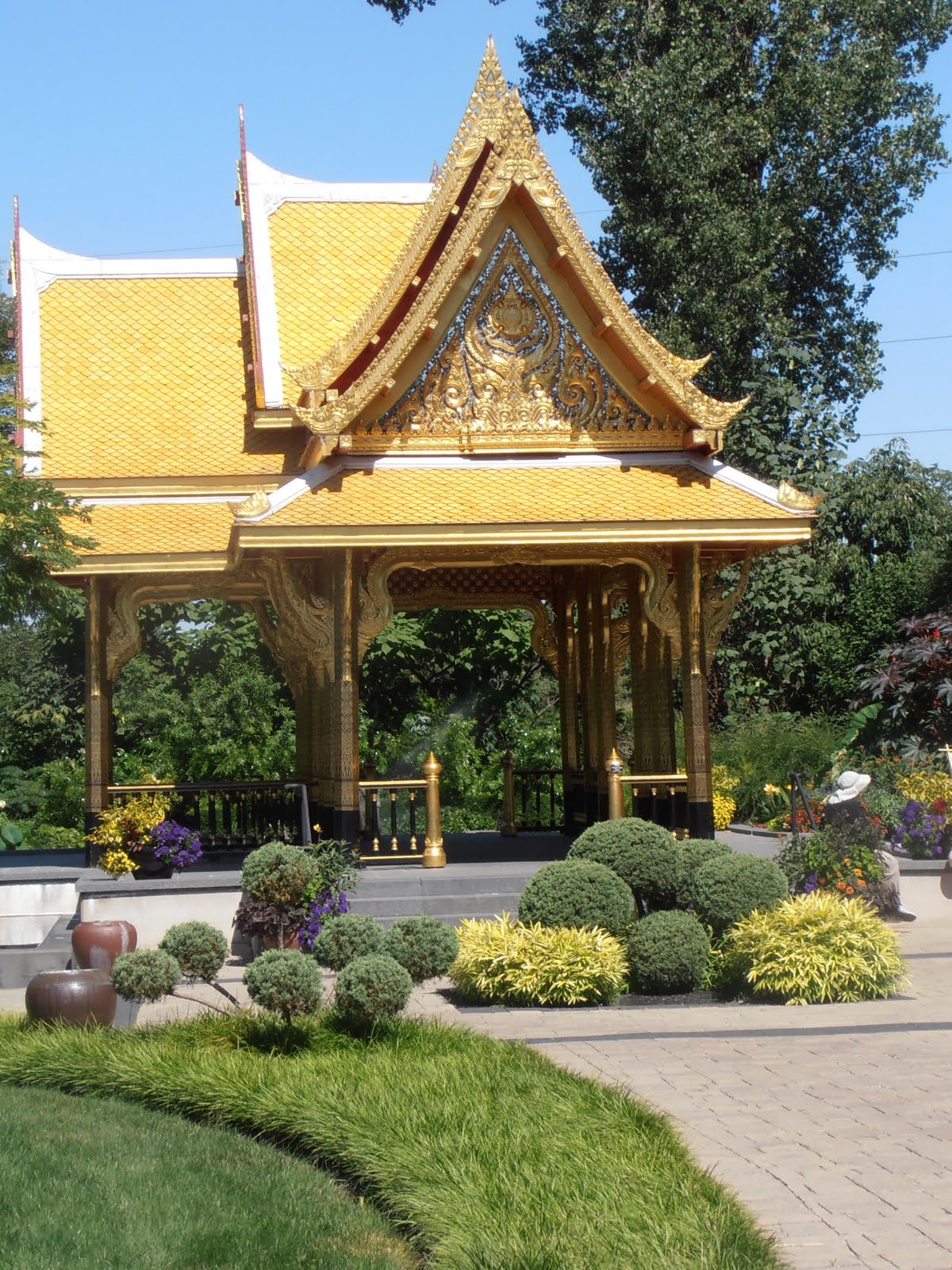
The Olbrich is a public garden owned by the City of Madison and operated by it in partnership with the non-profit Olbrich Botanical Society. It is part of a large park on the shore of Lake Monona. The property belonged to Michael Olbrich, a lawyer who was a disciple of Robert LaFollette, the progressive Republican senator and presidential candidate. He offered to donate the land to the city to be named "Robert LaFollette Park", but the offer was refused because of objections to the name due to LaFollette's opposition to World War I. Olbrich later donated the land without requiring the association to LaFollette.
Construction of the botanical gardens did not start until 1970, and it has developed gradually since then based on availability of private grants and fundraising activities. It has been the subject of four master plans, the most recent of which was adopted in 2000.
Here are some features I particularly liked:
 |
| Julie, Michael and Amanda In Front of the Sunken Garden |
The Rock Garden, which highlights various dwarf evergreens. (The Missouri Botanical Garden in St. Louis has a very similar feature):

I think these are False Chamomile, but I'm not sure. If they are, they are the seed pods of an aster:

Water Lily:

Dinnerplate-sized hibiscus in the perennial garden:

Our last stop on the trip was at the Table Fifty-Two restaurant in Chicago. I don't know what was the bigger treat, eating southern cooking in a gourmet restaurant, or eating southern cooking in Chicago. We went at the recommendation of my niece Elizabeth, who is our own professional chef and taste expert. The food and its presentation were outstanding. I ate fried catfish with grits, collard greens and a hushpuppy. Julie had fried green tomatoes and pistachio-crusted chicken breast.
Tuesday, August 2, 2011
Jasper National Park, AB to Calgary, AB
Same-O, same-O. Refer to the tab for "Rockies"
Mileage: 248. Cumulative mileage: 10,077
Mileage: 248. Cumulative mileage: 10,077
Monday, August 1, 2011
Edmonton, AB to Jasper National Park, AB
I spent three days in the Canadian Rockies. The pictures are extensive, and are under the separate tap of "Rockies".
Mileage: 333. Cumulative mileage: 9,829
Mileage: 333. Cumulative mileage: 9,829
Subscribe to:
Posts (Atom)